
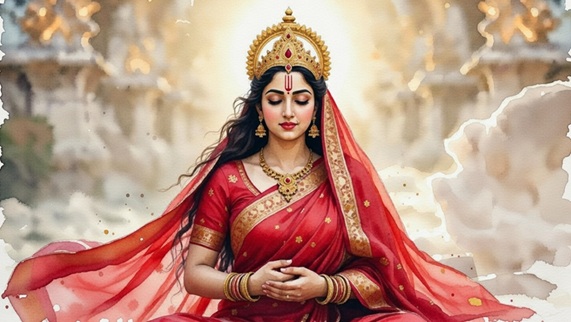
Maya
Maya (माया) is one of the most important and profound concepts in Hinduism, especially in Vedanta philosophy.
Maya is the power of Brahman which is the source and creator of this world.
Adi Sanakara mentioned in Vivekchudamani verse 108 :
अव्यक्तनाम्नी परमेशशक्तिः अनाद्यविद्या त्रिगुणात्मिका परा ।
कार्यानुमेया सुधियैव माया यया जगत्सर्वमिदं प्रसूयते ॥ १0८ ॥
“Maya, is the power of the Lord. She is without beginning, is made up of the three Guṇas and is superior to the effects (as their cause). She is to be inferred by one of clear intellect only from the effects She produces. It is She who brings forth this whole universe.”
Different Meanings of Maya in Hinduism
- In early Vedic texts → Maya often meant the magical power of the gods (especially Indra or Varuna) — the ability to create illusions or wonderful forms.
- In later philosophy (especially Upanishads and Puranas) → It gradually became the cosmic creative/veiling power.
But the most famous and systematic explanation of Maya comes from Advaita Vedanta (non-dual philosophy), mainly through Adi Shankaracharya (8th century).
Maya according to Advaita Vedanta
In Advaita, only one thing is ultimately real (Sat): Brahman — the pure, infinite, changeless consciousness, without any second thing.
Everything else that we see (world, body, mind, time, space, individuality) appears real but is not ultimately real.
Maya is the name given to this mysterious power that makes the unreal appear real.
Shankara describes Maya with three famous characteristics:
- सदसद्विलक्षणा (sadasadvilakṣaṇā) — Neither fully real (sat) nor fully unreal (asat)
- Not real → because it disappears in Jnana (true knowledge)
- Not unreal → because it is actually experienced (we do see the world)
- अनिर्वचनीया (anirvachanīyā) — Indescribable / cannot be logically explained completely You cannot say it is “this” or “that” — it is beyond normal logic.
- ब्रह्माश्रया (brahmāśrayā) — Depends completely on Brahman Maya has no independent existence. It is Brahman’s own power, like the power of the sun to shine.
Classic Example given by Shankara — Rajju-Sarpa Nyaya (Rope-Snake)
- You walk in dim light → see a rope → mistake it for a snake → get frightened, heart races.
- When light comes → you realize “Oh, it was only a rope, never a snake.”
- The snake was never really there, but the fear and experience were real while the illusion lasted.
Similarly:
- Brahman = the Rope
- World + individual (jiva) = the Snake (appearance)
- Maya = mistaken perception that creates the illusion
The moment Self-knowledge (Atma-Jnana) dawns (“I am Brahman”), Maya is sublated (lifted), just like the snake illusion vanishes.
Two Powers of Maya
Shankara mentions two main functions of a Maya in Vivekchudamani verse 144
एताभ्यामेव शक्तिभ्यां बन्धः पुंसः समागतः ।
याभ्यां विमोहितो देहं मत्वात्मानं भ्रमत्ययम् ॥
“It is from these two powers that man’s bondage has proceeded – beguiled by which he mistakes the body for the Self and wanders (from body to body).”
- Avarana Shakti (veiling power) → covers / hides the true nature of Brahman → We forget we are infinite Brahman and feel “I am small, separate, limited.”
- Vikshepa Shakti (projecting power) → projects the entire universe of names and forms → This is why we see diversity, birth-death, pleasure-pain etc.
Summary Table – Status of Different Things
| Level | What appears real | Ultimate status | Example |
|---|---|---|---|
| Paramarthika (Absolute) | Brahman only | Absolutely Real | Rope |
| Vyavaharika (Empirical) | World, you, me, karma | Relatively Real | Snake |
| Pratibhasika (Illusory) | Dream objects, mirage | Apparently real | Dream snake |
Most people live in vyavaharika satya (empirical reality) — that’s why we suffer. The goal of Advaita is to rise to paramarthika satya through knowledge → then Maya is seen as mithya (neither fully real nor fully unreal).